

Understanding the arrangement and purpose of letters in a dressage arena is essential for riders at every level. These markers are more than just decorations—they serve as crucial reference points for executing precise movements and transitions during tests and training sessions. Whether you’re preparing for your first competition or looking to refine your skills, getting to grips with the logic behind these letters can make a significant difference in your riding accuracy and confidence.
Dressage arenas come in two standard sizes: the small arena (20m x 40m) and the standard arena (20m x 60m). Both use a specific set of letters placed around the perimeter and, in some cases, within the arena itself. These markers guide riders through patterns and help judges assess the accuracy of each movement. For those new to the discipline, the arrangement may seem arbitrary at first, but there is a long-standing tradition and practical reasoning behind each placement.

For those interested in equestrian safety, it’s also important to consider equipment choices. For example, how to find the right riding helmet for your head shape can enhance both comfort and protection during training and competition.
Origins and Purpose of Dressage Letters
The use of letters in dressage arenas dates back to early cavalry training, where markers helped riders perform complex maneuvers with precision. Today, these letters are a universal standard in competitions worldwide. Their primary function is to provide clear points of reference for both riders and judges, ensuring that movements are performed at the correct locations within the arena.
Each letter corresponds to a specific spot along the arena’s boundary. Riders use these points to initiate transitions, circles, and other movements, while judges use them to evaluate the accuracy and quality of each exercise. The system is designed to create a fair and consistent framework for all participants, regardless of the arena’s location or the level of the test.
Layout of Letters in a Standard Dressage Arena
The standard dressage arena measures 20 meters wide by 60 meters long. The perimeter is marked with a series of letters placed at specific intervals. Here’s how the markers are typically arranged:
- A and C are located at the short ends, directly opposite each other.
- B and E are centered on the long sides.
- K, F, M, and H are placed at the corners and quarter points on the short ends.
- Additional markers—P, R, S, and V—are positioned along the long sides between the main corner and center letters.
Some advanced tests also use interior markers such as D, L, X, I, and G, which are aligned along the centerline. These help riders execute movements like halts and rein backs with greater precision.
Small Arena Letter Arrangement
For training and lower-level competitions, a smaller arena size of 20 meters by 40 meters is often used. The letter layout is slightly different, with fewer markers:
- A and C at the short ends.
- B and E at the midpoints of the long sides.
- K, F, M, and H at the corners and quarter points.
This simplified setup helps beginners focus on mastering basic movements without the complexity of additional markers. As riders progress, they transition to the larger arena and learn to navigate the expanded set of reference points.
How to Memorize Arena Letters
Many riders find it challenging to remember the sequence and placement of arena markers, especially when first starting out. Several mnemonics and memory aids have been developed over the years to make the process easier. For the standard 20×60 meter arena, a popular phrase is:
“All King Edward’s Horses Can Make Big Fences.”
This sentence helps riders recall the order of letters around the outside of the arena: A, K, E, H, C, M, B, F. For the additional markers on the long sides, another phrase is often used:
“Pretty Red Socks Very Pink Roses.”
These memory tricks can be especially useful during competitions, where nerves and pressure can make it easy to forget the correct sequence.
Using Arena Markers for Training and Competition
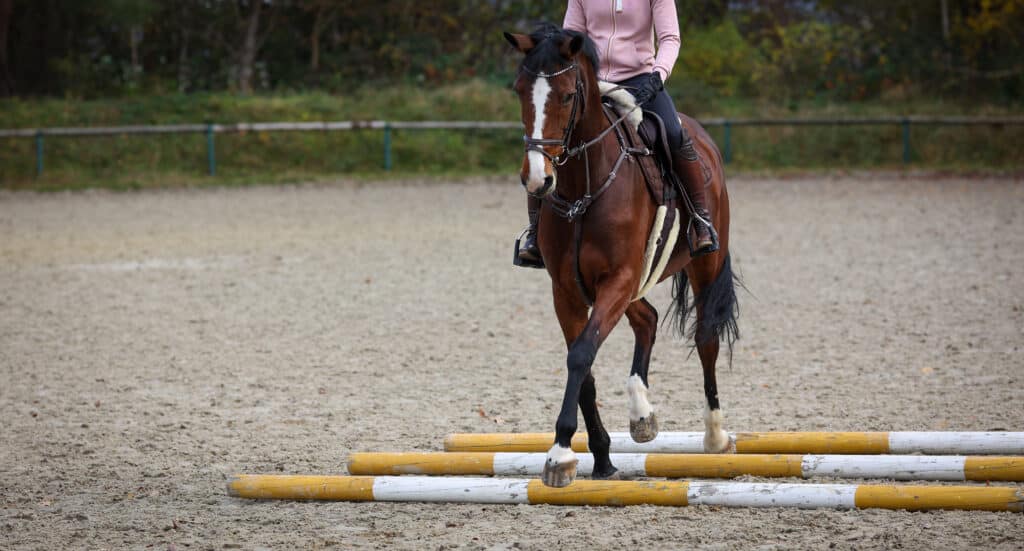
Markers are not just for show—they play a vital role in both daily schooling and formal tests. Riders use these points to plan transitions, circles, and lateral movements. Practicing with a clear understanding of the layout helps develop straightness, balance, and timing. For instance, when riding a 20-meter circle at B or E, knowing the exact location of these markers ensures the shape and size of the circle are correct.
During competitions, judges expect movements to be performed precisely at the designated letters. Consistent use of these reference points can lead to higher scores and more accurate riding. For tips on improving performance, consider reading how to maximise your dressage marks through balance, suppleness, and collection.
Common Questions About Dressage Arena Markers
Many newcomers wonder why the letters seem to follow no logical order. The truth is, the origins are somewhat mysterious, with some theories suggesting they relate to historic stabling arrangements or military drills. Regardless of their beginnings, the current system is universally recognized and forms the foundation of modern dressage training.
It’s also important to note that while the markers themselves are standardized, the physical signs used in different arenas may vary in size, color, and style. What matters most is their correct placement and visibility for both riders and judges.
Additional Resources and Related Topics
Beyond learning the arena markers, riders should also focus on other aspects of safety and performance. For example, understanding the difference between UK and US riding standards can help those competing internationally. Additionally, proper helmet fit and maintenance are crucial for safety; see our guide on the impact of age on helmet protective foam for more information.
FAQ
What do the letters in a dressage arena mean?
The letters serve as reference points for riders and judges. They indicate where specific movements should be performed and help ensure accuracy during tests and training sessions.
How can I remember the order of the arena markers?
Many riders use mnemonics or memory aids, such as “All King Edward’s Horses Can Make Big Fences,” to recall the sequence of letters around the arena. Practicing regularly in the arena also helps reinforce their locations.
Are the letters the same in every country?
Yes, the arrangement of markers is standardized internationally for both small and standard dressage arenas. This consistency allows riders to compete and train anywhere with the same reference points.
Do the markers have to be a certain size or color?
While the placement of the markers is standardized, the size and color of the physical signs may vary by facility. The key requirement is that they are clearly visible to both riders and judges.
Why are there extra letters in the larger arena?
The additional markers in the 20×60 meter arena allow for more complex movements and transitions, which are required in higher-level dressage tests. They provide extra guidance for both riders and judges during advanced routines.